
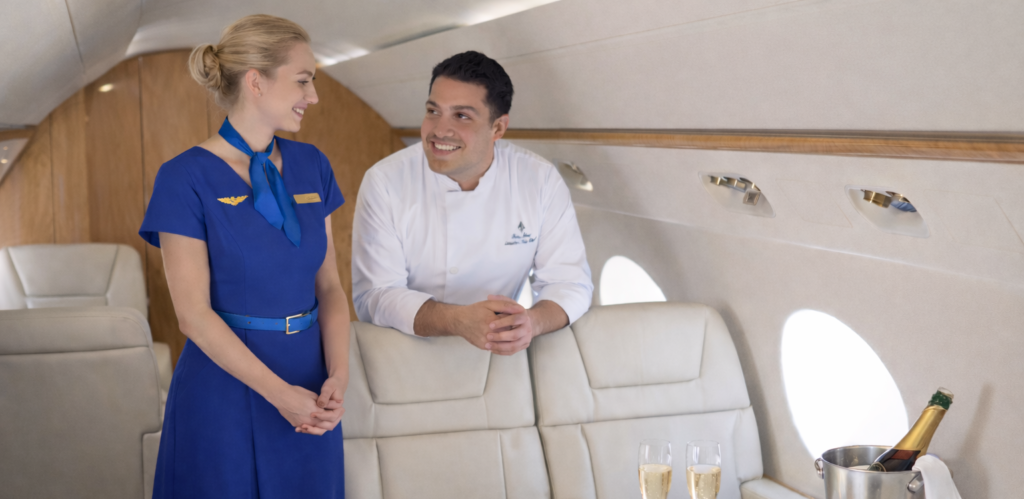
The most common assumption we hear from jet owners is simple: “We have a galley, so we are set.” After more than thirty years placing private chefs in the most demanding kitchens across the continental US, including those at forty thousand feet, we can tell you the galley is the easy part. Cooking on a private jet is a separate discipline, governed by physics, regulation, timing, and trust. A chef who is brilliant on the ground can fail in the air without the right preparation, and a chef who understands the environment can make a multi-course dinner over the Atlantic feel effortless. Below we break down the real constraints, and how the best chefs work around them.
Altitude changes how food cooks and how it tastes
At cruising altitude the cabin is pressurized, but conditions still differ sharply from a kitchen at sea level. Cabin pressure is lower, humidity drops, and that shifts the behavior of nearly every cooking process. Liquids boil at lower temperatures, heat moves differently, and timing becomes unpredictable. Even with excellent equipment, food comes out dry, uneven, or overcooked when the chef treats the galley like a home kitchen.
Recalibrating flavor for the sky
The factor that surprises owners most is taste. At altitude, the palate loses roughly thirty percent of its sensitivity to salt and sweetness. A dish seasoned perfectly on the ground reads as flat once airborne. The chefs our placement experts look for design menus around this fact rather than fighting it. In practice that means:
- More acidity to keep flavors bright and present
- More umami to carry depth when salt perception drops
- Stronger, more layered flavor profiles overall
This is not guesswork seasoning at the last minute. It is menu architecture that assumes a dulled palate from the start. Some airframes help here. The Dreamliner platform, for example, runs higher cabin humidity and a lower cabin altitude, which preserves flavor profiles better than older designs and rewards a chef who builds menus around fresh, clean ingredients.
The galley is small, so the real work happens on the ground
Even on the largest aircraft, galley space is finite. A chef is typically working with compact ovens, limited refrigeration, and minimal prep surface. On narrow-body VIP jets the constraint is severe, and on ultra-long-range flagships the service area can be efficient but still tight. Trying to fully cook a meal onboard often makes the result worse, not better.
The strongest results come from a disciplined split between ground and air:
- Smart prep on the ground, where space, time, and proper equipment exist
- Finishing, reheating, and plating in the air, where the chef controls only the final steps
This is why workflow matters more than raw cooking talent in a galley. A skilled chef stages dishes so that a tighter prep area becomes elegant plated service, transforming compact equipment into a refined dining stage. The difference between scale and constraint is real. A widebody platform can give a chef something close to a boutique restaurant workspace, while a compact flagship demands that organization and aviation-specific experience do the heavy lifting.
Safety and timing on the client’s clock
Turbulence and securing the galley
Safety always comes first in the air. Every item has to be secured, and meals have to be designed so they can be plated quickly even when conditions change mid-flight. A menu that depends on a calm cabin and a long, uninterrupted plating window is the wrong menu for a jet. The right chef plans for turbulence the way a ground chef plans for a rush.
There is no normal schedule
On a private jet, the schedule belongs to the guests. Breakfast might be served at midnight. Passengers eat when they want, not when it is convenient for the kitchen. On top of that, every preference carries weight: dietary restrictions, wellness routines, and cultural expectations all have to be honored at the moment the guest decides to eat. Speed and range compress this further. On the fastest long-range jets, time zones blur and the culinary window shifts in flight, so a chef has to perform at the highest level while effectively outrunning the clock.
Sourcing, compliance, and crossing borders
International travel adds a layer that has nothing to do with cooking. You cannot bring any ingredient anywhere. Countries enforce strict rules on fruits, vegetables, and meats, so a menu has to be planned for compliance as much as for flavor. A beautiful dish that gets confiscated at customs is a failed dish. Business aviation operates inside a dense framework of operational and regulatory standards, and crews coordinate closely with the wider industry, including organizations such as the National Business Aviation Association, to keep flights compliant. The chef’s provisioning plan has to fit inside that same framework.
This is where placement and logistics meet. Our six national offices, in New York, Los Angeles, Palm Beach, Dallas, San Francisco, and Washington D.C., manage the sourcing and vetting that make the transition from ground to air work. Provisioning for a twenty-hour intercontinental flight is a different problem than provisioning a short hop, and it requires a chef who can maintain consistency from takeoff to landing across changing rules and limited resupply.
Why the right chef is a placement decision, not a hiring afterthought
Pulling all of this together, cooking on a private jet is the simultaneous management of altitude, space, timing, safety, and global logistics. A chef who is excellent in one of these areas and weak in another will be exposed on a long flight. The reason we vet for aviation-specific experience is that the airframe sets the rules, and the chef has to know them before takeoff.
- Can they redesign a menu for a dulled palate at altitude?
- Can they split prep between ground and air without losing quality?
- Can they plate through turbulence and serve on the guest’s schedule?
- Can they provision legally across borders for long-haul routes?
When the answer to all four is yes, the passenger notices none of it. The meal simply feels effortless. That is the standard we hold for every placement, on every airframe.
The takeaway
A galley is equipment. Mastering the environment around it is the job. The owners who get this right treat the chef as part of the aircraft’s capability, not a catering afterthought, and they staff accordingly. If you are outfitting an aircraft or upgrading your onboard culinary program, the chef you place is the difference between a galley and a kitchen in the sky. To match your aircraft and your routes with a chef who has flown them, speak with our placement team.
