

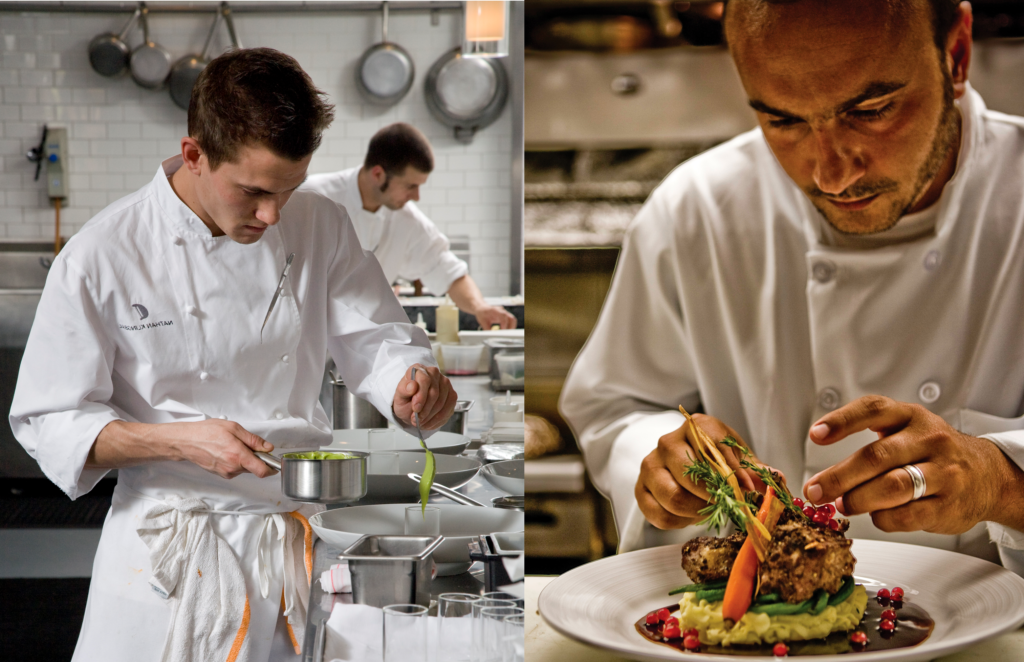
Every season, accomplished restaurant chefs walk away from line positions they spent years earning. They are not leaving because they have lost their passion for cooking. They are leaving because private service offers something the restaurant model rarely can: better pay, real creative control, a schedule built around a life, and the chance to build a lasting relationship with the people they cook for. After more than 30 years placing chefs in private households, we have watched this shift accelerate, and we understand exactly what drives it.
The financial case for going private
Restaurant compensation is tied to forces a chef cannot control. Food costs, slow nights, thin margins, and seasonal swings all decide what a kitchen can afford to pay. A talented chef can deliver an exceptional plate and still see erratic income because the economics of the dining room set the ceiling.
Private service changes the equation. A private chef commands high compensation by providing exclusive, high-touch services to an elite clientele. The specialized skills that earn applause in a restaurant become a direct asset in a private household, and they are paid for at a level the restaurant business cannot match. Transitioning into a high-income bracket lets a chef monetize craft and experience in a way a traditional kitchen simply does not allow.
Part of what makes this possible is the nature of the client. Private households hiring a full-time or seasonal chef are not looking for the lowest price. They are looking for the right person, someone who can run a kitchen, manage sourcing, handle dietary needs, and execute at a high standard without supervision. When a chef is selected for that kind of trust, compensation reflects the responsibility. The pay is also more predictable, because it is set by an agreement with the household rather than by how many covers came through the door on a given night.
The broader profession gives useful context here. The U.S. Bureau of Labor Statistics describes chefs and head cooks as a skilled occupation with a wide pay range, and private placement sits at the upper end of that spectrum, where individual reputation and discretion carry real weight.
Creative freedom instead of repetition
In a restaurant, a chef is often bound by a fixed menu and the monotony of high-volume repetition. The same dishes are fired hundreds of times a week, plated to a standard, in volumes that leave little room to experiment. Consistency is the product, and that consistency can become a creative cage for someone with ambition.
A private role reverses that. The chef plans full gourmet menus, sources and experiments with global ingredients, and introduces styles that are not found in standard dining rooms.
What creative control looks like day to day
- Menu authorship. The chef designs around a specific household, its tastes, and its occasions, rather than around what sells at volume.
- Ingredient freedom. Budgets and access often allow ingredients that a restaurant cost sheet would never approve.
- Room to innovate. New techniques and personal flair are encouraged, because the chef is cooking for a discerning palate that values originality.
This is the part many chefs describe as the most rewarding. They are creating something close to art for an audience that notices, and that level of personal innovation is hard to find behind a busy pass. A private chef can build a menu around a single dinner, refine a dish over several services, and respond to a client’s reaction in real time. That feedback loop, between the chef and the people actually eating the food, is direct and personal in a way that a high-volume kitchen rarely allows. Over time it becomes a genuine creative practice rather than a production line.
A schedule that protects the chef
Restaurant work usually controls a chef’s life. Nights, weekends, holidays, and double shifts are the norm, and burnout is a predictable result. A private career allows for a better balance.
That balance is not the same as an easy schedule. A private chef adapts to a client’s dynamic timetable, and the work can be demanding when the household is active. The difference is structure. Within that partnership, a chef can shape the rhythm of the week to prevent burnout while still delivering maximum results. For chefs who have spent a decade or more inside restaurant hours, the ability to plan their own time is often the single largest reason they make the move.
The arrangement is a partnership, and partnerships are negotiated. A chef and a household agree on expectations: how many meals, which days, travel requirements, and time off. Those terms are set up front, which means the chef knows what the commitment is and can build a sustainable career around it. That clarity is rare in restaurant work, where the next rush always sets the schedule. It is also what makes a long career in private service realistic, rather than a few intense years followed by exhaustion.
Stability through partnership
Restaurants close, ownership changes, and concepts get reinvented. Even a strong kitchen offers limited continuity for the people working in it. Private service builds stability through a direct, ongoing relationship between a chef and a household.
Why the relationship matters
- Continuity. Working with one client or family over time creates a steady professional foundation rather than constant turnover.
- Trust. A chef earns the loyal admiration of clients through a personalized partnership, and that trust translates into long, stable engagements.
- Recognition. The chef’s full proficiency is seen and valued by the people who matter most, instead of being one credit among many on a menu.
For chefs ready to make this transition, the path forward is concrete. If you are a high-level chef looking to take the next step, explore current private chef jobs and register to be considered for placements that fit your skill and your goals.
What this means for restaurant chefs weighing the move
The chefs who thrive in private service are usually the ones who were already at the top of the restaurant world. They have the technique, the discipline, and the standards. What they are looking for is a setting that pays for that excellence directly, gives them control over what they create, lets them protect their own time, and builds a lasting relationship instead of constant churn. Private service delivers all four.
For many serious chefs, the question is no longer whether to make the move, but when—and how to find the right private chef placement to do it successfully.
