

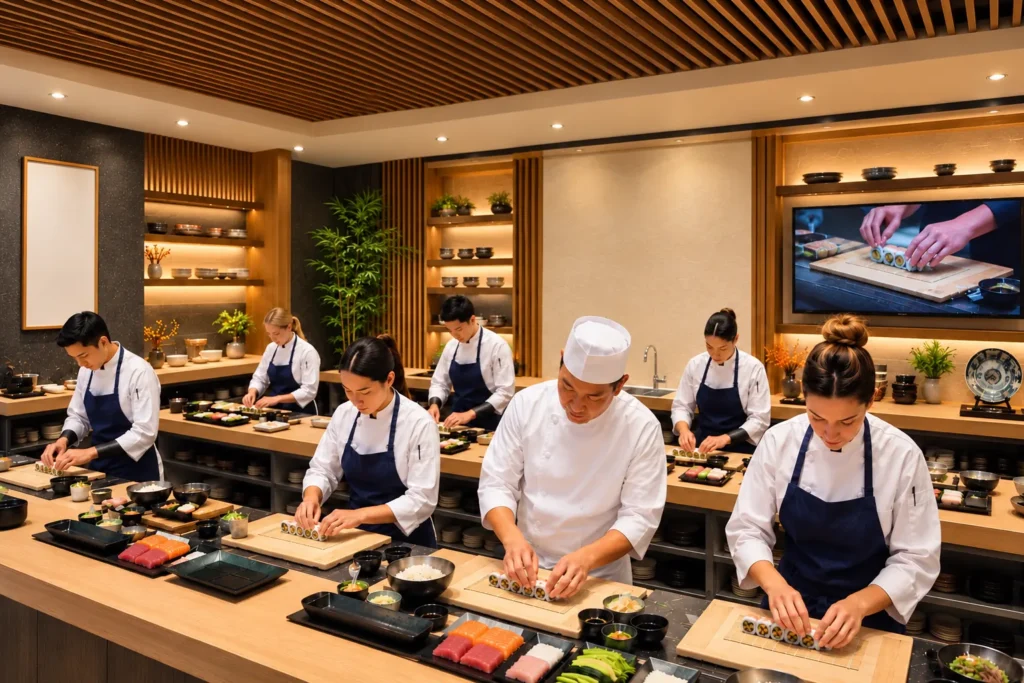
The private chef market has changed significantly, and the clients who hire through us know it. Households across Beverly Hills, Bel Air, Malibu, New York, and Palm Beach are more nutritionally informed than ever. They work with physicians, nutritionists, and functional medicine specialists, they follow specific dietary protocols, and they expect their chef to be ahead of the curve rather than catching up to it. Over more than 30 years of placing chefs into private households, we have watched one pattern hold steady: the chefs who command the best placements and the longest tenures are the ones who never stop learning.
Why Continuing Education Matters in Private Service
A private chef who stops learning stops growing. That is not a slogan. It is what we observe every time we match a chef to a household at the upper end of the market. Clients are choosing protocols and frameworks for health, ethical, and environmental reasons, and they want the food to be genuinely excellent rather than a compromise. Meeting that standard requires a chef who keeps adding to both culinary technique and nutritional knowledge.
The good news is that continued education in private service is concrete and accessible. It takes three main forms: working stages in serious kitchens, formal coursework in specialized cooking, and structured study of nutrition. Each one widens the range of households you can serve, and range is exactly what the private market rewards.
Stagiaires: Learning Inside the Best Kitchens
One of the most valuable investments a private chef can make is a stagiaire, a working stage inside a professional kitchen. Doing stages in Michelin-starred restaurants exposes you to the highest levels of technique and standards in the industry. It also signals to prospective clients and to us, as your agency, that you take your craft seriously.
Fine dining is only one direction to go. Stages in restaurants that specialize in a particular cuisine bring new flavors, ingredients, and methods into your repertoire. Consider time in kitchens built around:
- Thai cooking, for balance of heat, acid, salt, and aromatics
- Japanese technique, for precision, knife work, and restraint
- Indian cuisine, for spice layering and regional depth
- Modern Mexican, for masa, salsas, and contemporary plating
In private service, range matters. A chef who can cook authentically across multiple culinary traditions is far more valuable to a household than one limited to a single style.
Specialized Cooking Courses That Set a Chef Apart
Beyond the stage, formal coursework gives a chef the technical foundation to execute specialized cooking with confidence instead of improvising. Several disciplines stand out in the placements we fill.
Plant-Based and Vegan Cooking
Demand for plant-based cooking in private households has grown steadily and shows no sign of slowing. A formal course gives you the foundation to work confidently with the full range of vegetables, legumes, grains, and fruits, and to build menus as satisfying as anything you would produce in a traditional kitchen.
Bread Baking and Pastry
Artisan bread baking has become a meaningful differentiator. Sourdough, gluten-free loaves, and traditional European breads bring something to a household that most chefs cannot. Good courses cover ingredient selection, fermentation, shaping, scoring, proofing, and the science behind crust and crumb. Pastry is a separate discipline entirely, and chefs with formal pastry training command attention. Laminated doughs, tarts, plated desserts, and confectionery raise the dining experience in a way that is immediately apparent, and even a working knowledge of pastry fundamentals sets a chef apart.
Dietary Frameworks: Keto, Paleo, and Allergen-Free
Several dietary frameworks are now firmly established in the private market, particularly among performance-oriented and longevity-focused clients. Each one rewards real training:
- Ketogenic and low-carbohydrate cooking means building genuinely satisfying, nutritionally complete meals around healthy fats and quality proteins, not simply removing carbohydrates.
- Gluten-free and allergen-free menus go well beyond substitution. They require understanding alternative grains like quinoa, buckwheat, and millet, plus dairy-free, nut-free, soy-free, and shellfish-free technique that keeps quality intact.
- Paleo and whole-food cooking centers on minimally processed, nutrient-dense ingredients: quality meats, seafood, vegetables, fruits, nuts, and seeds, with grains and dairy largely excluded.
A chef who can handle complex allergen combinations without losing quality is invaluable to the right household, and the ingredient focus of paleo work aligns naturally with the values of most high-end clients.
Mindful Sourcing and Conscious Cuisine
An increasing number of clients think about food in terms of sustainability, environmental impact, and overall wellbeing. Locally sourced, organic, seasonal cooking is no longer a niche preference. It is a standard expectation in many of the markets where we operate. Understanding the sourcing landscape in your area, building relationships with farmers and producers, and cooking with genuine attention to the origin and quality of ingredients is part of what it means to be a serious private chef today.
Nutrition for Health Conditions: The Highest-Value Skill
The most significant area of continued education is clinical nutrition, understanding how food intersects with specific health conditions. Clients managing cancer, diabetes, cardiovascular disease, autoimmune conditions, or other chronic challenges increasingly want chefs who can work within medically guided nutritional frameworks. Pursuing formal coursework in nutrition, and building the ability to collaborate productively with a client’s medical team, raises a chef’s role from cook to genuine health partner. It also opens doors to placements that are simply not available to chefs without that knowledge.
For chefs who want recognized credentials alongside this study, professional certification programs such as the American Culinary Federation certifications offer a structured way to document skill and advancement that clients and agencies recognize.
The Takeaway
The private chef market rewards range, depth, and the willingness to keep learning. Every course, every stage, and every new dietary framework you master is an investment in your career and in the value you bring to the households you serve. Clients at the top of this market are not looking for a chef who has stopped growing. They are looking for a partner who keeps pace with their health, their values, and their expectations.
If you have the qualifications and the commitment to work at this level, with a minimum of eight years of high-level culinary experience, a background in fine dining or luxury hospitality, documented private household experience, and fluency in health-forward cooking, we invite you to register with Private Chefs Inc. and join our talent roster. Our network connects qualified private chefs with UHNW households, celebrity clients, and prominent families across the United States.
