

The Staffing Perspective Podcast: Inside Executive Placement and Modern Agency Architecture

An inside look at the evolving world of executive staffing, as Private Chefs Inc. founder Christian Paier joins The Staffing Perspective Podcast to discuss the importance of personal relationships, professional judgment, and technology in placing exceptional talent within ultra-high-net-worth households

with Mandel Ray Robinson Jr.

Bespoke recruitment and executive talent acquisition have always rested on subtle, non-negotiable fundamentals: discretionary judgment, cultural intuition, and institutional trust. In dedicated estate staffing—where culinary talent is placed directly inside ultra-high-net-worth households—success cannot be reduced to an automated filter or generic platform. Yet behind every high-touch placement practice lies an essential operational backbone: how talent pipelines are managed, how multi-market relationships are sustained, and how modern technology is introduced without eroding white-glove standards.

I recently sat down with Mandel Ray Robinson Jr., Co-Founder and Managing Partner of Tampa-based Syncbridge Group, as an invited guest on The Staffing Perspective podcast. Mandel has built a series examining the operational realities of recruitment firms today. Joining his broadcast provided a timely forum to reflect on thirty years of running Private Chefs Inc., placing long-term estate talent across major hubs, and discussing how technology should support—never replace—the human discernment that defines elite staffing.

The Staffing Perspective: Candid Dialogues with Industry Operators

What sets Mandel’s approach apart on The Staffing Perspective is its direct focus on active operational challenges rather than generalized corporate summaries.

Through his inaugural series, Mandel has curated conversations with recruitment founders tackling distinct facets of talent placement across North America:

Carla Moreira (EA Partners), exploring cross-border talent acquisition and the discipline of preserving human connection across distributed candidate pipelines.

Amanda Timm (Abstract Recruiting), examining how specialized boutique search agencies scale operations without diluting the core principles behind their founding success.

Dan Hodgson (Workforce Hope) — Rethinking Workforce Shortages Beyond Local Talent. A conversation about rural workforce shortages, the hidden costs of turnover, and how global talent sourcing and skills-based hiring can help businesses build stronger teams for the long term.

Stepping in as the fourth guest in this opening slate, our discussion moved into the highly confidential world of private estate placement. Over three decades of managing dedicated placements for family offices, royal residences, and private estates, the standards required to represent talent have remained exacting. Our dialogue focused on the delicate intersection of legacy vetting practices and the modern operational systems necessary to manage talent across

competitive markets like Los Angeles private chefs, New York, Dallas, and Palm Beach.

The Systemic Challenge: Growth vs. Effort

A recurring principle in Mandel’s work—both on the air and within Syncbridge Group—is that scaling bottlenecks are rarely caused by a lack of effort. Placement directors and boutique founders consistently log long, demanding hours managing volatile candidate pools. Instead, friction almost always emerges from disconnected internal infrastructure.

“Growth problems are rarely solved by effort alone. More often, they come down to the systems a business is operating with—how leads are generated, how follow-up happens, how teams communicate, where manual work slows things down, and how effectively technology is being used.”

— Mandel Ray Robinson Jr.

During our interview, we analyzed how easily high-touch agency leaders can become bogged down by administrative friction. When candidate records, reference histories, and client preferences remain trapped across fragmented spreadsheets and disparate inboxes, recruiters spend hours on mechanical tasks rather than high-value talent vetting. Mandel’s mission with Syncbridge Group is to design operational foundations that remove that administrative friction.

What We Explored: Modernizing the Bespoke Placement Firm

Reflecting on the discussion, our conversation centered on four core themes shaping specialized agency leadership:

1. Protecting Discretion and the Human Touch: Algorithms can parse culinary resumes, but they cannot assess kitchen temperament, discreet household presence, or interpersonal chemistry with a principal. Modern systems should organize candidate portfolios and verification workflows, freeing leadership to focus on nuanced candidate assessment.

2. Multi-Market Coordination Without Operational Drag: Operating domestic placement desks across multiple primary regions demands clean, automated tracking systems so client requirements and vetted talent databases sync across offices without manual delays.

3. Continuous Client and Candidate Education: From managing expectations around estate compensation to guiding talent on professional presentation—themes we explore regularly on The Private Chef Show—an agency must operate as an authoritative industry educator, not merely a transactional job board.

4. Systems Built Around Human Judgment: Technology must serve clear business needs. By stripping away administrative overhead, boutique agencies can focus on deep relationship

building and long-term placement retention.

Practical AI and Business Architecture at Syncbridge Group

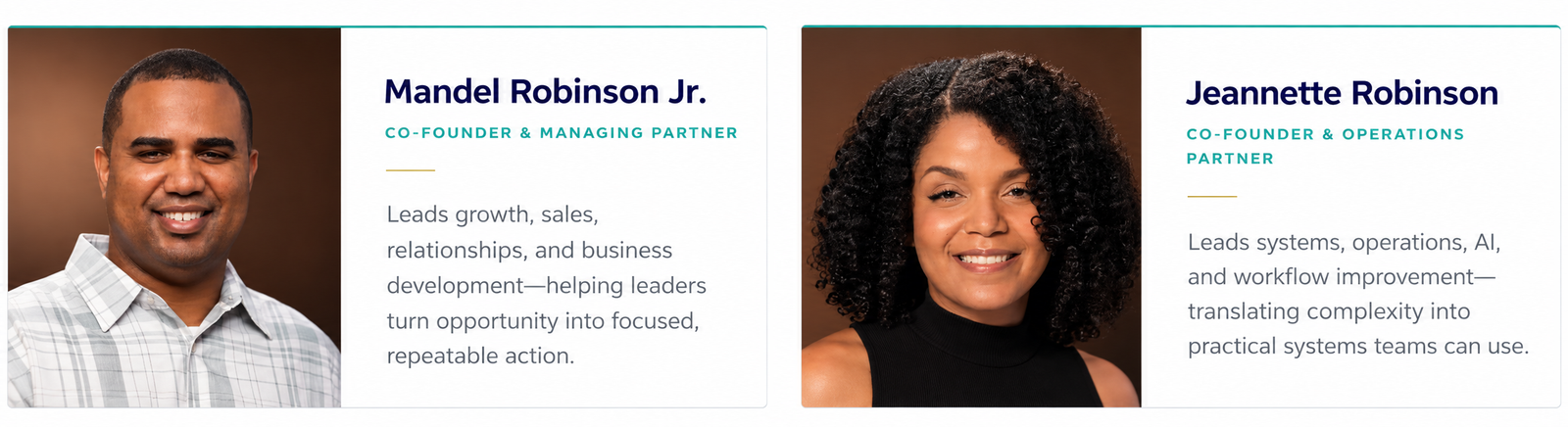
Co-founding Syncbridge Group alongside Operations Partner Jeannette Robinson, Mandel brings more than 17 years of experience spanning sales engineering, business development, and financial services advisory, backed by an Entrepreneurial MBA from William Jewell College.

An Honored Listee in Marquis Who’s Who, Mandel has focused Syncbridge Group on helping staffing, recruitment, and executive search practices build sustainable operational clarity through four strategic phases:
Full Episode Transcript


Mandel Robinson Jr.: Welcome to The Staffing Perspective. My name is Mandel Robinson Jr., and today I’m joined by Christian Paier, CEO and President of Private Chefs Inc. Christian has spent more than 30 years working in private chef placement. Christian, it’s amazing to have you today. How are you doing, sir?

Christian Paier: I’m wonderful. Thank you so much for having me on, Mandel. I really appreciate it.

Mandel Robinson Jr.: My pleasure. My first question is how you went from being a chef to working with clients and realizing you could build this business. Could you take us through that journey?

Christian Paier: I was a chef in Europe, moved to America, and worked at the Breakers Hotel in Palm Beach. Then I came to Los Angeles and became a private chef to a couple in Bel Air. They entertained every week with movie screenings, and there would be dinners for 18 to 25 people. I met those guests regularly. Sometimes they would call me. The first was Sidney Sheldon, the writer, who was a friend of my employer. He said, “I need a new chef. Do you know anybody?” I connected friends with jobs. Several calls later, another client reached out, and I decided right then on the phone that I was going to start an agency.

He told me, “No problem. I don’t mind paying. Just send me the resumes.” In 1995, I didn’t have a computer or the internet, so we faxed the resumes. A week later, he hired the chef. We sent an invoice for $5,000, and a week later, I received the check. I thought, “Wow, this actually works.”

After that, things moved faster. My initial office was a restaurant on Sunset Plaza. Every morning I’d sit there for three or four hours. Chefs would come for interviews, sit with me, and show me their resumes. Word spread quickly because I represented private chefs only. Domestic agencies handled chefs as a side activity. I knew it needed to be specialized, run by people who were chefs and understood private service.

The first write-up was a three-page feature in Vogue. Then word spread to Forbes and The Wall Street Journal. Over 30 years, we’ve had 84 write-ups in major publications, including The New York Times and the LA Times, and the BBC flew me to England for a live television interview. We expanded from Los Angeles into New York, Palm Beach, Dallas, and San Francisco. We’ve been doing this for 30 years.

Mandel Robinson Jr.: You’ve seen a lot over 30 years. What has changed most about clients’ needs since you started?

Christian Paier: There is a huge gap between then and now. After five years in business, I had signed up about 180 chefs in Los Angeles. Now we have almost 600 in LA alone, most actively working full-time in private homes.

Back then, clients primarily wanted classic French cuisine, and there were more live-in jobs. These days, live-in is maybe 3%. Over the last ten years, clients’ travel and fine-dining experiences broadened their palates. They might want Thai, Chinese, or Italian, and chefs have to accommodate specialty diets like low sodium or specific allergen needs.

Households with children require adjustments too. Children gravitate toward the kitchen, so you build a good relationship, include them, and teach them about food so their palates expand. Some estates now have three full-time chefs to cover breakfast, lunch, and dinner seven days a week. You might have four people in a household with four different diets.

At the same time, most clients eat simply day-to-day. Michelin-caliber food is lovely when entertaining, but people don’t eat that way every day. Most want a solid two-course dinner: an appetizer and a main. It depends on the location too; a family on a ranch in Texas might prefer steaks, barbecue, and down-home cooking rather than high-end cuisine.

Mandel Robinson Jr.: What tells you a placement will work between a client and a chef?

Christian Paier: The most important thing is that clients give us as much detail as possible about their household lifestyle. Is the household very corporate, wanting someone quiet who keeps their head down and does the job? Or is it busy and informal? The more we know, the better the match, which creates a long-term placement.

When we interview chefs, we evaluate whether they have the temperament for a private home. In a restaurant, you’re in the kitchen and don’t deal with the family. In a private home, noise and cleanliness levels are completely different. Everything has to be quiet, and you have to clean up as you work. In most households, nobody else cleans your dishes and pots.

In a restaurant, the guest eats what the chef decides. In a private home, it’s the opposite: you give them exactly what they want. If they want cereal for dinner, you give them cereal. If they dislike a dish, you say, “No problem. I won’t repeat it.” Keep a logbook, observe what comes back on the plates, and make meticulous notes about likes and dislikes. When they return tired from a long trip, you figure out what comfort food they need.

You also need to understand the dynamic of the household staff and communicate through the proper channels, whether that’s the estate manager, butler, or house coordinator.

Mandel Robinson Jr.: How have salaries changed, and what’s a realistic package for experienced private chefs today?

Christian Paier: In 1995, regular salaries were about $48,000 to $55,000. For a long time, $125,000 was the high end. Today, we’re seeing the highest levels we’ve ever seen.

The baseline is around $130,000 to $140,000, but typical compensation runs between $150,000 and $180,000. Top positions demand more. We have clients in the San Francisco Bay Area paying $250,000 to $300,000 for exact requirements.

Perks have expanded as well. Some jobs have intense periods—like summers in the Hamptons working six days a week—followed by weeks of travel downtime where the chef is paid year-round. Clients understand that chefs have a lifestyle to support; if you only pay when you use them, they won’t be available when you return. More clients now provide comprehensive health insurance. I recommend annual raises of 5% to 7% to retain talent long-term, along with holiday bonuses. This is someone in your home every day taking care of your wellness; when you take care of them, they stay.

Mandel Robinson Jr.: You’ve placed chefs for athletes, touring performers, and film productions. How do those assignments differ?

Christian Paier: For athletes, you need someone who has studied performance nutrition and knows what to feed them during competition versus the off-season.

Touring with a music artist or working on a film set is completely different. You might visit six cities in a week, cooking in hotel kitchens, field kitchens, on buses, or on private planes. There is no regular schedule; you’re on call around the clock. On a movie set, an actor might wrap filming at three in the morning and need a meal. It takes a specific type of chef who thrives on constant travel and irregular hours to keep that principal fueled and energized.

Mandel Robinson Jr.: How can a household tell whether an agency has the expertise to deliver?

Christian Paier: Ask how long the agency has been in business and how long they’ve operated in your specific market. Do they meet candidates in person? Have they represented them for years? An agent who has worked with a chef through multiple placements knows their real background, strengths, and which household environments suit them best.

It seems there’s a new agency every month. Finding resumes online is easy, but if you don’t know the chefs personally, you’re just throwing things at the wall. We even see overseas agencies creating US websites pretending they have a local presence. When issues arise, there’s no local support. Work with established agencies that have proven local depth and verified candidate rosters.

Mandel Robinson Jr.: Where can AI help in your industry, and what still needs direct human verification?

Christian Paier: AI can be useful for inventory tracking, organizing pantry supplies, or calculating timing when preparing unfamiliar menus.

The negative side is candidate authenticity. We see flowery introduction letters written by AI and exaggerated reference letters. Worse, some chefs submit AI-generated photos of dishes. A portfolio is supposed to represent your actual cooking. Having posted around 15,000 culinary photos over 18 years, I recognize real work versus synthetic or stolen photos. We check images and verify real backgrounds. You can use AI as an operational kitchen tool, but candidate representation has to be 100% genuine.

Mandel Robinson Jr.: What advice do you give chefs when preparing their resumes and meeting agencies?

Christian Paier: When I meet chefs, I review their resumes step-by-step. Don’t try to squeeze 20 years of experience onto one page. List your positions clearly: exact dates, property scale, cuisine types, and duties. Detail your versatility with specialty diets and family-friendly meals.

Presentation is crucial. Photos should be clean, approachable, and professional – wear a clean, pressed chef jacket with a neutral background, and smile. In interviews, be diplomatic and service-oriented. Humility and clear communication will open the door to top estates.

Mandel Robinson Jr.: For someone building a specialized agency, what is the single biggest lesson from your 30 years?

Christian Paier: Build your candidate roster before you try to scale. If you market heavily without a deep roster of vetted chefs, you will disappoint clients on your first opportunity. Start in an established metropolitan market, take the time to build personal relationships with talent, and grow steadily. In estate placement, client longevity and repeat business are everything. If you do exceptional work, clients stay with you for decades.

Table of Contents

Looking for a Private Chef?

PCI has placed elite private chefs with discerning clients since 1995. Let us match you with the perfect culinary professional.