
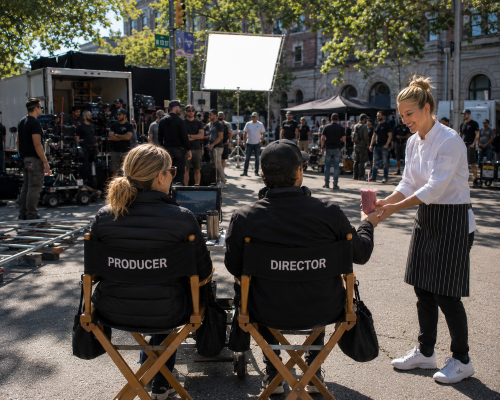
Cooking for an actor or director in Los Angeles during a major film or television production is one of the most demanding assignments a private chef can take. The work is not about a single beautiful plate served in a calm dining room. It is about fueling a performance across twelve and fourteen hour shooting days, adapting to a schedule that changes by the hour, and holding fine-dining standards in a trailer parked on a remote location. After more than 30 years placing chefs in the most exacting households and productions, we know exactly what separates a capable cook from a chef who can carry a principal through a multi-month shoot.
The Chef Is the Fuel Behind the Performance
A film set is an intense ecosystem defined by extreme physical demands, unpredictable shifts, and long shooting days. The chef’s primary mission, most of the time, is simple to state and hard to execute: keep the talent in top form. That means the food has to do real work. It has to supply the raw endurance a principal needs to perform at a peak level under hot studio lights and through high-intensity sequences, scene after scene, week after week.
Before production begins, the chef must have an exact understanding of the principal’s daily wellness parameters. This starts with establishing a direct line of communication with the talent’s personal team, so that every meal is built around the goals already set by their trainers, nutritionists, and personal staff. The chef does not guess. The chef confirms.
Precision Macro Tracking
To maintain an actor’s cognitive focus and physical energy across a long day, the macro-tracking has to be precise. The chef strategically balances three things:
- Clean carbohydrates timed to keep energy steady so the talent does not hit a wall mid-scene.
- Premium lean proteins to support recovery and sustained physical output.
- Complex fats for longer-burning fuel and mental sharpness under pressure.
When a role requires a dramatic physical transformation, these parameters become even more exacting. But even on a standard shoot, the goal is the same: a principal who stays resilient, sharp, and healthy through consecutive weeks of filming.
Mastering an Unpredictable Clock
On a movie set, the clock is completely unpredictable. A chef must adapt to notoriously odd hours, including frequent night shoots that run from sunset to dawn, all while managing a schedule with very limited time off. The chef might execute a high-calorie breakfast at four in the morning on a Tuesday, then serve a premium steak dinner at two o’clock in the morning on a Thursday. The body clock of the production rules everything, and the chef’s kitchen runs on that clock.
Tactical timing is the skill that defines an elite set chef. The chef has to be ready the exact second the director calls a wrap on a sequence, with hot, exactingly measured meals delivered instantly to the trailer. There is no room for a dish that needs another fifteen minutes when the talent has a narrow break before the next setup. The chef plans backward from the shooting schedule and stays one step ahead of it, even when that schedule changes without warning.
Building Flexibility Into Every Service
Because call times move, the chef prepares for several possible windows rather than one. Components are held at the right temperature and finished to order, so a meal can be plated in minutes whenever the break finally comes. This is the difference between a chef who reacts and a chef who is always ready.
Portability Without Compromise
Talent is constantly moving between a private trailer, the soundstage, and remote exterior locations. That makes portability a non-negotiable factor. The chef has to focus on sophisticated, nutrient-dense dishes that travel well: pristine seared proteins over vibrant grain salads, or elegant, tightly sealed fuel bowls that hold their quality on a busy set.
Getting this right depends on equipment as much as cooking. Investing in top-tier, heavy-duty airtight storage and premium mobile heat cases is essential, so that highly tailored meals stay fresh, temperature-safe, and visually stunning at any hour of the day or night. A meal that arrives at the trailer looking and tasting exactly as the chef intended, hours after it left the kitchen, is the standard.
Food Safety on Location
Moving food across a set introduces real food-safety risk, and the responsibility sits squarely with the chef. Meals that are packed, insulated, and transported still have to stay out of the temperature danger zone where bacteria multiply. Hot dishes need to stay genuinely hot and cold dishes genuinely cold, from the moment they leave the kitchen to the moment the talent eats. The same FDA-recognized time and temperature principles that govern any professional kitchen apply on location, and chefs who work productions stay fluent in them. The FDA Food Code is the foundation for the temperature control, holding, and cross-contamination practices a set chef relies on every day.
Practical Safeguards on a Busy Set
- Use calibrated thermometers, not guesswork, to verify holding temperatures before a meal travels.
- Pair heavy-duty airtight storage with mobile heat and cold cases sized for the transport time involved.
- Plan menus so that anything held for a long, unpredictable window is built to stay safe at that window.
- Treat every exterior location as a kitchen that has to meet the same standard as the home base.
Holding Standards in Remote Locations
The true test of an elite set chef comes when a production moves to remote areas for shoots that can last weeks or even months. Filming might take place on isolated coastal regions, deep in the mountains, or in international locations with limited local resources. In all of these settings, the standard cannot drop.
This often means the chef operates out of a customized luxury trailer, a modified production vehicle, or a local hotel kitchen nearby, packing a sophisticated mobile culinary infrastructure. Elite portable tools make it possible:
- Commercial induction burners that deliver real cooking power anywhere there is electricity.
- High-end immersion circulators for precise, repeatable results far from a fixed kitchen.
- Heavy-duty storage and transport cases that protect ingredients and finished meals across long distances.
The payoff is more than logistics. A consistent, high-performance meal delivered the same way every day gives the principal a vital sense of grounding stability across a long, multi-month shoot. When everything else about the schedule is chaotic, the food is one thing the talent can count on.
What This Means for a Production
Cooking on a film or television set rewards a specific set of skills: precise nutritional planning aligned with the talent’s personal team, the stamina to work odd hours, fluency in food safety on the move, and the ability to recreate a fine-dining kitchen in a trailer or hotel suite. Few chefs hold all four, and that is why production placement is its own discipline.
If you are staffing a production or representing talent who needs this level of support, we can help you find a chef built for the demands of the set. Contact Private Chefs Inc. to discuss your next placement, and we will match you with a chef who can fuel the performance from the first call time to the final wrap.
