

Cooking for a musician touring accross the US is one of the most demanding assignments a private chef can take. The artist moves between cities on a schedule that shifts without warning, performs under heavy physical strain, and depends on food to hold energy steady from soundcheck to encore. A chef who succeeds in this setting combines careful planning, deep adaptability, and the kind of culinary creativity that does not collapse the moment a full kitchen is unavailable. After more than 30 years placing chefs in private and high-profile settings, we know that touring work rewards preparation and punishes improvisation that was never thought through in advance.
Start With Dietary Restrictions, Not the Menu
The work begins long before the first show. Before the tour commences, the chef needs a clear grasp of the musician’s allergies, intolerances, and lifestyle choices. That may mean vegan, gluten-free, or a specific performance-based diet built around the demands of nightly shows. Guessing is not an option when the principal cannot afford to feel unwell on stage.
Communication with management is the mechanism that makes this work. The artist’s team holds the details a chef needs, and constant contact ensures the menu hits every requirement rather than approximating it.
What to confirm before the tour starts
- Allergies and intolerances, with the severity of each clearly understood.
- Lifestyle choices such as vegan or gluten-free eating.
- Performance-based dietary needs tied to the show schedule.
- The single point of contact on the artist’s team for last-minute changes.
Build the Menu Around Portability
Life on the road is fast moving, so portability is not a nice extra. It is the foundation of every dish. The chef should focus on food that packs easily, reheats well, and holds up when it is eaten on the go rather than at a set table. That points toward sophisticated grain bowls, hearty stews, and specialized pasta salads that travel without losing their quality.
Equipment matters as much as the recipe here. Investing in high-quality airtight storage keeps nutritious meals fresh for longer periods, which is exactly what a chef needs when the next chance to cook may be hours away and several cities removed.
Balance Nutrition for a Physically Demanding Schedule
Touring is physically demanding, and balancing nutritional needs is non-negotiable. The chef’s role is to incorporate a variety of lean proteins, whole grains, and fresh produce so the artist has sustained energy through every performance. A plate that satisfies in the moment but leaves the principal flat an hour later has failed at its only real job.
The components of a touring plate
- Lean proteins to support recovery between back-to-back shows.
- Whole grains for steady, lasting energy rather than a quick spike.
- Fresh produce to round out nutrition across long stretches of travel.
To reach what we call the gold standard, a chef can collaborate with a nutritionist to create a truly customized meal plan. For chefs building their understanding of how protein, grains, and produce work together over a demanding schedule, the Academy of Nutrition and Dietetics is a credible resource for grounding those decisions in sound practice.
Use Each City as Inspiration
One of the better parts of touring is the chance to embrace local flavors. Each tour location can serve as inspiration, and a thoughtful chef incorporates local ingredients and regional culinary traditions into the menu. This adds an element of surprise to the routine and lets the artist taste each unique destination instead of eating the same meals from one town to the next. It is a small touch that turns repetitive travel into something the principal looks forward to.
Plan for the Logistics of Travel
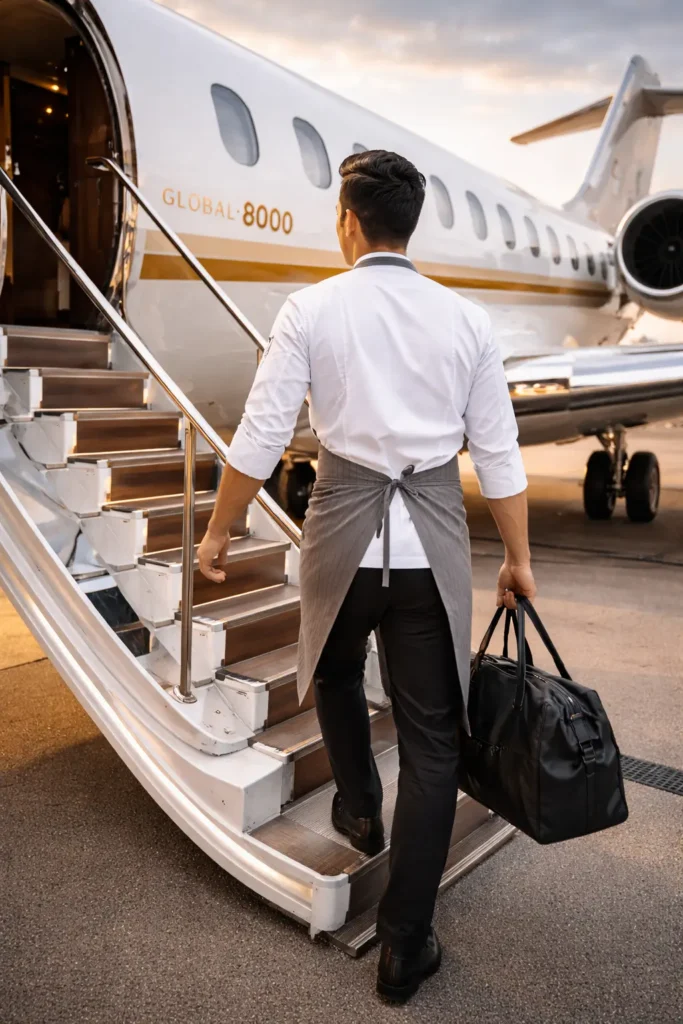
How the artist travels shapes how the chef works. While some musicians still prefer the classic tour bus, most top-tier performers and bands now move between cities by private jet. That changes the chef’s position in the schedule.
Traveling ahead of the principal
In many of these arrangements, the chef travels on a commercial airliner ahead of the group so that everything is prepared before the principal even touches down. The goal is a smooth transition from flight to a first-class meal, with no gap where the artist arrives and has nothing ready.
Working from the hotel kitchen
In a large share of these cases, the chef works directly out of the professional kitchen of the hotel where the client is staying. That gives the chef a real workspace rather than improvised conditions, and it keeps the meal service tied to where the artist actually rests between shows.
Cook With Limited Resources
Touring often means working without the full kitchen a chef would prefer. When that happens, creativity is what carries the work. The answer is to equip yourself with high-end portable tools and to master recipes that hold their flavor with minimal equipment.
- Induction burners that give controlled heat almost anywhere.
- Electric grills for protein and produce when a stove is not available.
- A core set of recipes designed around minimal equipment, so quality never depends on a kitchen that may not be there.
Flexibility and Communication Are the Real Job
Tour schedules are notoriously unpredictable, and a chef’s greatest assets are flexibility and steady communication. Staying in constant contact with the artist’s team and being ready to adapt to last-minute changes is what delivers the reliable culinary experience high-profile artists depend on. The food matters, but the ability to keep delivering it through chaos is what separates a chef who survives a tour from one who is asked back for the next.
The Takeaway
Cooking for musicians on tour rewards chefs who plan around restrictions first, build menus for portability, keep nutrition steady through a punishing schedule, and stay flexible when the itinerary shifts under their feet. It is specialized work, and the right match between artist and chef makes the difference between a tour that runs smoothly and one that does not. If you need to find a chef for an upcoming tour or place one with a client for the long term, contact our placement team and we will help you find the right fit.
