
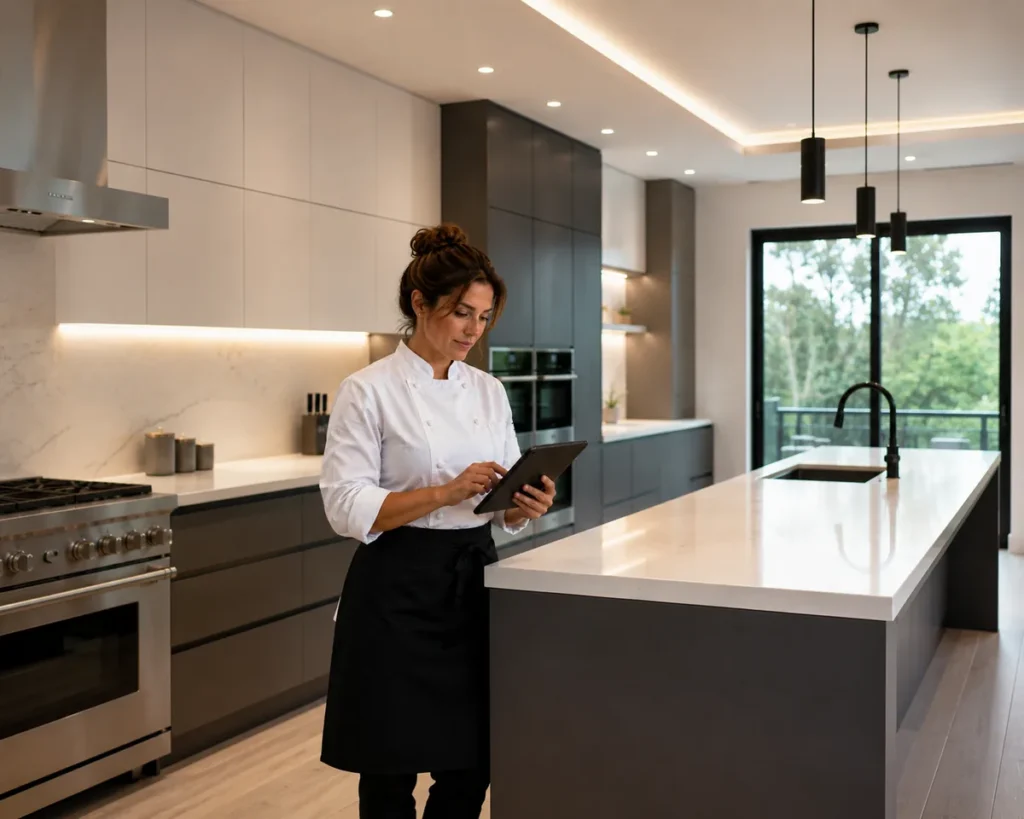
Artificial intelligence is steadily making its way into the private chef world, but it is not transforming the profession at its core. Private service has always been built on hands-on talent and human connection, and that does not change. What changes is the set of tools a chef can reach for. AI is a helpful, fast-developing assistant that individual chefs can already use today, and the smart-kitchen hardware found in top estates keeps getting more sophisticated. After more than 30 years of placing chefs in private homes, our work is knowing where these tools help, where they cross a line, and why the chef stays central to all of it.
Where AI genuinely helps an individual chef today
Many brilliant culinary professionals are masters in the kitchen yet find the administrative side of marketing themselves a challenge. This is the first place AI earns its keep. It is an excellent assistant for assembling a professional resume, finding polished wording, or drafting an elegant biography for agency presentation. None of that touches the food. It helps a talented chef present a career history that already exists.
Initial menu engineering for complex diets
AI is also practical for early-stage menu work when the requirements are technical. If a chef inputs a specific list of medical guidelines, food allergies, or macro targets provided by a client’s nutritionist, AI can cross-reference ingredients quickly to confirm that baseline menu concepts are safe and tailored to the household. This is a support function, not a creative one. The chef sets the standard and the final concept. The tool simply checks the groundwork against a long list of constraints faster than reading labels by hand.
Estate management and kitchen logistics
The fastest movement is in day-to-day estate management and back-of-house logistics. AI-powered tools are changing how private chefs and luxury households stay organized, and the most useful right now is inventory.
A private chef can use AI as an intelligent kitchen inventory assistant simply by photographing pantry shelves, refrigerators, freezers, wine rooms, or dry storage areas. The AI analyzes those images, identifies visible ingredients, spices, oils, sauces, produce, proteins, and beverages, and generates an organized inventory list within seconds. The old routine of clipboards and spreadsheets gives way to a faster workflow: take a photo, receive an organized inventory and a starting point for menu planning.
What this back-of-house assistant does
- Track pantry, refrigerator, and freezer inventory in real time
- Reduce waste and avoid duplicate purchases
- Monitor low-stock items before they run out
- Brainstorm menu ideas based on ingredients already in the household
This matters most in the ultra-high-net-worth market, where kitchens are expansive, often spread across several residences, yachts, or guest properties, and managed by multiple staff. A chef can document inventory at a Malibu estate, an Aspen residence, a Palm Beach property, or onboard a mega-yacht with photos from a phone or tablet. The same technology integrates with smart kitchen automation, where AI-enabled refrigerators with internal cameras track expiration dates, monitor consumption patterns, and centralize refrigeration alerts and wine room management in one platform.
The boundaries a professional never crosses
Because AI is still a developing tool, there are strict limits, and in private service these are non-negotiable. The profession runs on personal authenticity and absolute trust inside someone’s home. Cross a line once and the damage rarely recovers. Standards bodies are still working out how AI systems should be measured and governed, and useful background on that effort is available from NIST Artificial Intelligence. Until that maturity arrives, the responsibility for judgment sits entirely with the chef.
Never pass off AI work as your own culinary vision
A chef should never use AI to create dishes or culinary concepts and then present them as personal work. True culinary artistry comes from a chef’s own experience and palate. Even a chef with the technical mastery to recreate an intricate, vertically plated dish, like the cucumber, caviar, and floral plating shown on our website, undermines their own value by presenting an algorithm’s idea as an original vision. Principals pay for a specific culinary perspective, not a generated one. AI can sort ingredient logistics. The art on the plate must be the chef’s.
Never fabricate references or portfolio images
We are starting to see AI-written professional references, and this should simply never happen. To an experienced estate manager or a seasoned placement agency, AI-generated reference letters are easy to spot. They lack genuine human nuance, real behavioral anecdotes, and the authentic tone of a real previous employer. A reference that looks manufactured raises an immediate red flag about a chef’s entire career history. The same rule applies to portfolios. Using AI-created images to represent your food is a definitive no. In the ultra-high-net-worth market, a single instance of misrepresentation will permanently blackball a chef from elite households.
From digital software to high-end hardware
The other half of the modern estate kitchen is the equipment. At this level, cutting-edge is not about gimmicks. It is about bringing restaurant-grade precision and consistency into a residential space. Here is the kind of gear top-tier chefs are working with, with the prices given on the show.
- Invisible Induction Countertops ($3,500): Induction coils integrated beneath a single porcelain or natural stone slab, leaving an uninterrupted surface with no visible cooktop.
- Miele Dialog Oven ($7,899): Uses electromagnetic waves to monitor food density in real time and cooks evenly and significantly faster than conventional ovens.
- Gaggenau Combi-Steam Ovens ($10,699): A luxury-home gold standard, giving commercial control over humidity, multi-stage programs, and sous-vide.
- Molecular Devices Induction Woks: Flush-integrated induction wok systems replacing traditional high-heat gas setups in modern renovations.
- TurboChef Ovens ($19,048): High-speed hybrid units combining microwave, convection, and air impingement, built into staff kitchens and wellness pantries where speed matters.
- Rational iCombi Pro ($28,968): A true AI-assisted combi oven that senses load size and condition and adjusts humidity, air velocity, and temperature for high-volume events.
- Irinox Residential Blast Chillers ($30,310): Shock-freezes food instantly, locking in color, texture, and safety without the ice crystals that ruin premium ingredients.
- Pacojet ($7,899): Micro-purees deep-frozen ingredients under pressure for ultra-smooth sorbets, savory purees, and textures impossible to achieve by hand.
Notice that the hardware extends the chef rather than replacing the chef. Even the AI-assisted Rational iCombi handles humidity and air velocity so the person can focus on the food and the guests. Precision tools raise the floor of consistency. They do not supply the taste or judgment that decides what belongs on the plate.
The takeaway
Used selectively, AI is a real asset for the administrative and operational side of a private chef’s work: resumes and biographies, dietary cross-referencing, photo-based inventory across multiple properties, and smart-kitchen systems that keep a sprawling household organized. Used dishonestly, for fake culinary concepts, manufactured references, or AI-generated food images, it ends careers. The dividing line is simple. Let the technology handle logistics and let the talent own the art. Sourcing chefs who balance modern efficiency with old-school professional integrity is what we do best, and if you want that standard in your own home, connect with our national placement team. No matter how advanced the kitchen gets, it is the talent and integrity of the chef that truly matter.
